
Contract Manufacturing Scope for Home Fragrance, and Its Paper Trail
A contract manufacturing project is only as clear as its scope lines, and each scope line should come with a document that proves it was performed. Development, filling, decoration, packing, storage and export paperwork are separate items, and a supplier can hold some while subcontracting others. The handover file is where that becomes visible: the released specification, the retained reference, batch and fill records, test reports, component and artwork files, and an ownership statement. Ask for the file's contents in the contract, before the first unit is filled.
Key takeaways
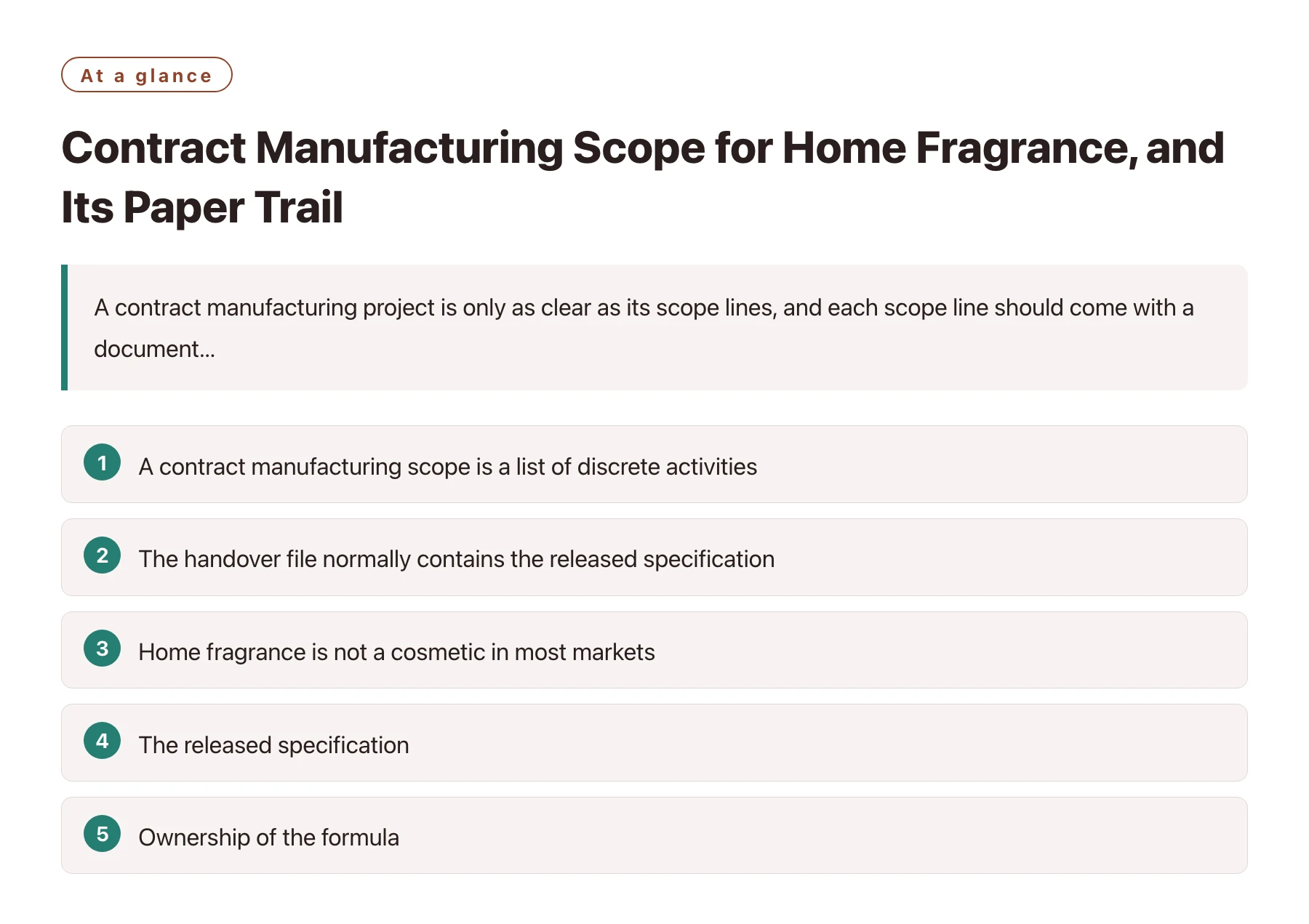
- A contract manufacturing scope is a list of discrete activities, and each activity should name who performs it and which document proves it.
- The handover file normally contains the released specification, a retained reference sample, batch and fill records, test reports, component and artwork files, and an ownership statement.
- Home fragrance is not a cosmetic in most markets, so the file is usually built around fragrance material standards, labelling and packaging obligations rather than a cosmetic product dossier.
- The released specification, not the approved sample by itself, is what a factory matches against on a reorder.
- Ownership of the formula, the artwork and any custom mould decides what the brand can take with it if the relationship ends.
Buyers tend to negotiate price first and scope second, which is backwards. Price is a consequence of scope: whether the vessel is stock or tooled, whether decoration is in-house, who warehouses the components, and who prepares the export papers are all scope questions that move the unit cost.
The second half of the same conversation is evidence. A scope line without a document is a promise, and promises are difficult to review six months later when a second order has to match the first.
Scope line, the document that proves it, and when it matters
| Scope line | Who normally performs it | Document that proves it | When you need it |
|---|---|---|---|
| Scent development or selection | Factory perfumery or a named external house | Formula card with dosage and the category statement | Before sampling closes |
| Bulk manufacture and filling | Factory production site | Batch record with fill weights and the retained sample | At handover and on every reorder |
| Vessel decoration and assembly | In-house line or a specialist decorator | Approved decoration proof and the first-article sign-off | Before bulk decoration starts |
| Stability and compatibility testing | Factory laboratory or a named third party | Test report naming the format tested and the protocol | Before the formula is frozen |
| Packing and warehousing | Factory or a contracted logistics provider | Packing specification, carton artwork and stock records | At the point of change control |
| Export documentation | Factory, forwarder or both | Packing list, commercial invoice and any conformity papers | Before the container is booked |
Two columns do the work here: who performs the activity, and what proves it. Where a scope line is subcontracted, the control question is who signs off the output, and that answer belongs in the contract.
The retained reference is the hinge of the whole file
Every other document describes the product; the retained reference is the product, held still. A sealed sample tied to a batch number is what lets a second order be compared against the first instead of argued about, and it is the reason a reorder does not need to restart the development loop.
That is also why the released specification matters more than the marketing sample. The specification records the measurable things — fill weight, fragrance load, colour, viscosity where relevant, wick or reed specification — and it is the version that survives staff changes on both sides. A handover pack that contains only a pretty sample and a certificate of analysis has skipped the part that governs production.
Compliance does not all sit in one file
Home fragrance sits outside cosmetic rules in most markets, which changes what the file contains. Instead of a cosmetic product dossier, the emphasis falls on the fragrance materials used, the labelling shown to consumers, and the packaging itself. Fragrance materials are restricted by product category, and the published standards library is the reference most suppliers work from when they set limits for a candle, a diffuser or a spray [1]. Ask which category statement covers your formats and who issued it.
Packaging now carries its own obligations in some markets. European rules are tightening around reuse, refill and recyclability, which means the vessel and carton choices made at the start of a project can turn into compliance items at the end of it [2]. The practical form this takes at handover is a statement about the packaging components, not just about the product inside them.
Independent testing is the third leg. Where a market, a retailer or a buyer's own policy asks for verification, the report should name the laboratory, the protocol and the format tested, and it should be released in a way the buyer can reuse [3]. Reports issued to the supplier's account and shared as a PDF are harder to rely on in a later market entry than reports the buyer can point to directly.
What ownership has to say, and why it belongs in the same folder
Ownership questions arrive late and cost the most when they do. Who owns the fragrance formula, who owns the artwork files, who owns the mould if the vessel was tooled for the brand, and what happens to each of those if the relationship ends — these are answered by the contract, and the handover file should reflect the answers. Intellectual property arrangements are usually a matter of trade-secret protection and written assignment rather than registration, which makes the wording, not the filing, the important part [4].
A supplier that can describe its own manufacturing background in specific terms is usually easier to hold to a scope, because the description already separates the activities it performs from the ones it does not. Reading Xuelei's manufacturing background is a reasonable way to see what that kind of disclosure looks like before you ask for it from anyone else.
The handover conversation should end with a named contact and a review date, not a farewell. The first reorder is the real test of a manufacturing relationship: it either matches the reference or it does not. Some contract manufacturing work is delivered as one programme covering development, filling, decoration and packing, which is the arrangement described under Xuelei OEM manufacturing; when the steps are split across suppliers, the handover file becomes the only place where the whole product is documented at once.
What to do in the first month after handover
Store the retained sample in conditions that match the specification, with the date and batch noted on the box. File the test reports by market rather than by date, so a later entry can reuse them, and check that the safety testing behind a claim is documented at the level the market asks for safety testing in perfume manufacturing rather than assumed from the certificate.
Then review the specification against what actually shipped. Discrepancies found in the first month are a conversation; discrepancies found in the second season are a dispute. The whole purpose of the paper trail is to move each disagreement to the earliest possible moment, when it is still cheap.
If a supplier resists listing the handover documents in the contract, that is information. Most are willing to name them; the ones that are not usually have a reason you would rather hear now.
Sources
- IFRA Standards Library (International Fragrance Association) —— The IFRA Standards Library lists the restrictions the fragrance industry applies to individual fragrance ingredients, based on safety assessments; it is the reference point for compliant fragrance formulation.
- European Commission: Packaging Waste and the PPWR —— EU rules on packaging and packaging waste, including the Packaging and Packaging Waste Regulation requirements on recyclability and design.
- SGS: Cosmetics, Personal Care & Household Testing —— Testing, inspection and certification services for cosmetics and personal care, including microbiological, stability and safety testing aligned with cosmetics GMP.
- WIPO — World Intellectual Property Organization —— The UN agency for intellectual property; resources on industrial design and patent protection relevant to product and packaging design.
Frequently asked questions
What is normally in a home fragrance handover pack?
The released specification, a retained reference sample tied to a batch, batch and fill records, stability and compatibility reports, artwork and component files, packing requirements, and a statement of who owns the formula, the artwork and any tooling.
Is home fragrance regulated like a cosmetic?
In most markets it is not, because the product is not applied to the body. That shifts the compliance work toward fragrance material restrictions by product category, labelling, and packaging rules rather than a cosmetic dossier.
Why does the released specification matter more than the approved sample?
Because it holds the measurable parameters that production has to match — load, fill weight, colour, wick or reed specification. A sample shows what was agreed once; the specification is what makes it repeatable.
Who should own the mould for a custom vessel?
The answer is commercial rather than technical, but it needs to be written down. If the brand pays for the tooling, the agreement should say so and describe what happens to the tool if the relationship ends or the supplier changes.
Do test reports from one supplier travel to a new market?
Sometimes, if they were issued under an arrangement the buyer can reference and the protocol matches what the new market asks for. Reports shared informally from a supplier's account are much harder to reuse, which is why release terms belong in the contract.
Threads that don't expire. Boards that don't disappear.
Spin up a free IchigoBBS install in under 12 minutes — or migrate an existing community with one click.