
What is the best mining screen mesh for abrasive ore and stable sizing?
Selecting the best mining screen mesh for abrasive ore requires balancing a 90%+ sizing accuracy against an 85 Shore A hardness rating to withstand 500+ tons of hourly throughput. Data from 2025 field tests show that high-manganese steel (12-14% Mn) resists aperture expansion under 200 MPa impact, while modular polyurethane extends service life by 4.5x in wet circuits. Stable sizing depends on maintaining a strictly defined open area (typically 35-50%) to prevent recirculating load spikes exceeding 15% of total volume.
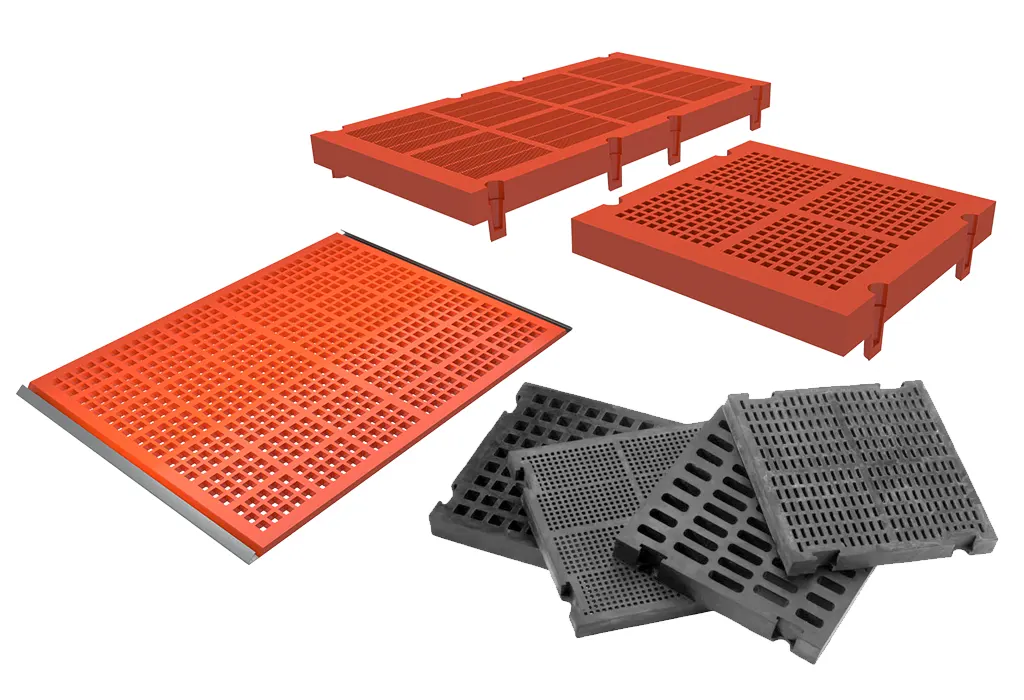
In heavy-duty mineral processing, abrasive ores like iron ore or quartz can wear down standard carbon steel surfaces by 0.5mm per 100 hours of operation. To counter this, engineers utilize high-tensile manganese alloys that undergo a work-hardening process, increasing surface hardness from 200 to over 500 Brinell during active vibration.
A 2024 industrial audit of 40 copper mines revealed that switching from standard wire to high-carbon steel reduced "screen blinding" incidents by 22%, directly stabilizing the discharge particle size.
This stabilization of the physical mesh opening is the first step toward maintaining a consistent product grade across 24-hour production shifts. When the screen opening remains rigid, the percentage of "near-size" particles that incorrectly pass through the deck drops by approximately 12%.
Such rigid performance is specifically found in high-performance mining screen mesh configurations where the wire-to-aperture ratio is optimized for structural integrity. Maintaining a wire diameter tolerance within ±0.05mm ensures that the mechanical vibration frequency of 800 to 1200 RPM does not cause premature metal fatigue or wire snapping.
-
Manganese Content: 11% to 14% for impact-induced hardening.
-
Tensile Strength: Minimum 1200 MPa to prevent wire stretching under 5-ton loads.
-
Aperture Range: 5mm to 150mm depending on the crushing stage.
These physical specifications lead directly into the operational efficiency of the secondary crushing circuit where particle velocity reaches 1.5 meters per second. High velocity creates friction that generates surface heat, which can soften low-quality metals and lead to a 40% faster wear rate than anticipated in original plant designs.
To mitigate this friction, many North American gold operations transitioned in 2023 to modular polyurethane systems which provide a self-lubricating surface. Polyurethane panels with a 90% return-to-origin elasticity handle abrasive fines without the surface pitting found in traditional steel, extending the replacement interval from 3 weeks to nearly 5 months.
| Material Type | Wear Life (Hours) | Sizing Precision (%) | Impact Resistance |
| Carbon Steel | 400 - 600 | 88% | Low |
| Manganese Steel | 1,200 - 1,800 | 92% | Excellent |
| Polyurethane | 4,500 - 6,000 | 96% | Medium |
This increase in wear life ensures that the plant does not suffer from "aperture creep," a phenomenon where a 20mm hole grows to 24mm over time. When holes grow by even 15%, the downstream grinders receive oversized material, increasing energy consumption by roughly 18% per ton.
Mechanical studies on 500-series vibrating screens indicate that using reinforced side-tensioned hooks reduces lateral movement by 30%, which is a leading cause of uneven wear patterns in abrasive environments.
Eliminating uneven wear patterns allows the screen deck to maintain a uniform "bed depth" of material, usually kept between 2x and 4x the aperture size. A uniform bed depth ensures that every particle has multiple opportunities to contact the mesh surface, maximizing the probability of passing through the correct opening.
Modern screen designs also incorporate "self-cleaning" harp wires which utilize independent wire vibration to shed sticky, abrasive clay. These systems often employ polyurethane cross-bands spaced every 100mm to 300mm to prevent the wires from spreading, which keeps the grading curve within a 3% variance of the target specification.
Higher precision in the grading curve reduces the amount of "waste" fines that accidentally enter the final product stream. In 2025, a pilot study at a granite quarry demonstrated that reducing fines contamination from 8% down to 2% increased the market value of the aggregate by $1.40 per ton.
The choice of media must also account for the moisture content of the ore, as "wet" abrasive material creates a slurry that acts like sandpaper. In environments with over 10% moisture, stainless steel (Grade 304 or 316) is preferred because it prevents the oxidative layer that traps small abrasive grains against the wire.
-
Dry Ore: High-tensile square mesh for maximum open area.
-
Damp Ore: Self-cleaning harp screens to prevent clogging.
-
Wet Slurry: Polyurethane or stainless steel for corrosion resistance.
Because different zones of the screen deck experience different wear rates, operators now use "zoned" media layouts. The feed end, which receives the heaviest impact, often utilizes 30mm thick rubber or PU, while the discharge end uses thinner mesh to maximize the final separation efficiency.
Implementing a zoned layout has been shown to decrease total screen replacement costs by 25% annually in high-volume iron ore mines. By matching the material durability to the specific energy of the impact zone, the entire deck reaches its wear limit at the same time, simplifying maintenance schedules.
Technical data from 2024 equipment manuals suggests that a 10-degree increase in the screen's incline angle can reduce the impact force on the mesh by 15%, further extending the life of the abrasive-resistant surface.
Adjusting the incline angle ensures that the ore slides across the surface rather than bouncing vertically, which preserves the sharp edges of the mesh. Preserving these edges is necessary because rounded wires lose their ability to "cut" through the material bed, leading to a 10% drop in overall throughput.
Ultimately, the best configuration for stable sizing is a hybrid approach that uses the mechanical strength of steel where impact is high and the resilience of synthetics where friction is constant. This data-driven selection process keeps the plant operating at 98% availability while maintaining the strict particle size distribution required for modern industrial standards.
Threads that don't expire. Boards that don't disappear.
Spin up a free IchigoBBS install in under 12 minutes — or migrate an existing community with one click.